
For as long as I can remember, I have always had pride in my Croatian ancestry. I couldn’t tell you why exactly, but I have. I assume part of it is because humans naturally feel pride for where they are from and where their forefathers came from. Still, it felt bigger and more complicated than that. Why would this induce pride of all things? After all, it’s not like I had any choice in the matter of my lineage. I have earned trophies, accomplished physical feats I didn’t know I could, and graduated college, but my ancestry still fills me with as much, if not more, pride as those things. The other part of it, I think, is because there really aren’t that many Americans who have Croatian blood running through them. According to the United States Ancestry Census in 2020, only about .12% of folks in the U.S. are of Croatian descent. Now, I didn’t know this fact growing up; in fact, I only learned that when I began researching stats for this story. However, I have always known that I seemed to meet very few others whose families are Croats besides my own. I felt like I was part of a rare group of people in America.
Pride Before the Fall
When I was a kid, I heard my dad tell a joke about how to tell if someone’s family tree started in Croatia like ours did. He said, “If you meet someone with a last name that ends in ‘-ich‘ they’re probably Croatian; Polovich, Grgurich, Filipovich, Miletich. Even son-of-a-bitch.” At the time, I just thought it was humorous, but I have ended up using this advice far more than he probably realizes. I can’t even recall the number of times I have altered mundane conversations into discussions on where someone’s family originated from upon hearing the familiar “itch” sound at the end of a last name. Sometimes, they’ll tell me that their great-grandparents boarded a boat from Bosnia, or Serbia, or some other Slavic country, but oftentimes, they will say Croatia. Then, whether either of us is aware of it or not, we have a connection that makes our conversation friendlier, and I get the sense that we understand, and know one another better than we actually do. I can only assume that this is because they feel a sense of pride for where they come from, just as I do.
For instance, about six months ago, I was talking to a salesman who knocked on my front door. Usually, these kinds of interactions are quick and respectful. I try to end them before they really get going with an “Oh, no thank you. I’m good, really.” But in this case, I never even got to hear about whatever product or service he was going to pitch me because instead, after discovering we both had Croatian-sounding last names, we chatted about the land our families came from, and when they came to America, and how we never meet anybody with our ancestry. Eventually, though, he asked me if I had ever been to our fatherland or if I knew the language. I was a little ashamed to admit that I had never been there and didn’t speak a lick of Croatian. Following that interaction, I wondered if I was a poser, pretending to be proud of my heritage when really I knew nothing about it. I knew I had to change that.
Doubling Back
My not-so-distant ancestors first arrived in America back in 1913. My great-great-great grandfather came here a full year before his wife finally boarded a ship to go and meet him. They were only 19 years old. At the time I am writing this, I am 24. They were younger than I am today when they packed up and moved halfway around the world to start a new life. They are the only reason I am even here today. If they could do that five years younger than I am, then surely I can make the trek back around the globe and see where my family history began. And that’s what I did. I essentially doubled back on the path that my family had traveled for the past 100 years. And while they had to take slow boats that churned their way through the Atlantic for months, I simply hopped on a few planes to return to where they had started in a few days. I flew into Ljubljana, Slovenia, and from there, took a bus down a winding, shaky road to Portoroz before boarding another bus heading from the Slovenian coast down into the Croatian countryside. I was on my way to meet up with a tour group for the day to explore some of the rural parts of the country. I find that seeing someplace’s rural areas allows me to get to know that place better. I don’t think that big cities are good samples of places because they usually have a culture and an atmosphere all their own. The only way to truly know a place is to see the vast stretches of open land and meet the people who live there. Besides, my ancestors didn’t come from Croatia’s major hubs. They came from the rural towns scattered along the hilly landscape.
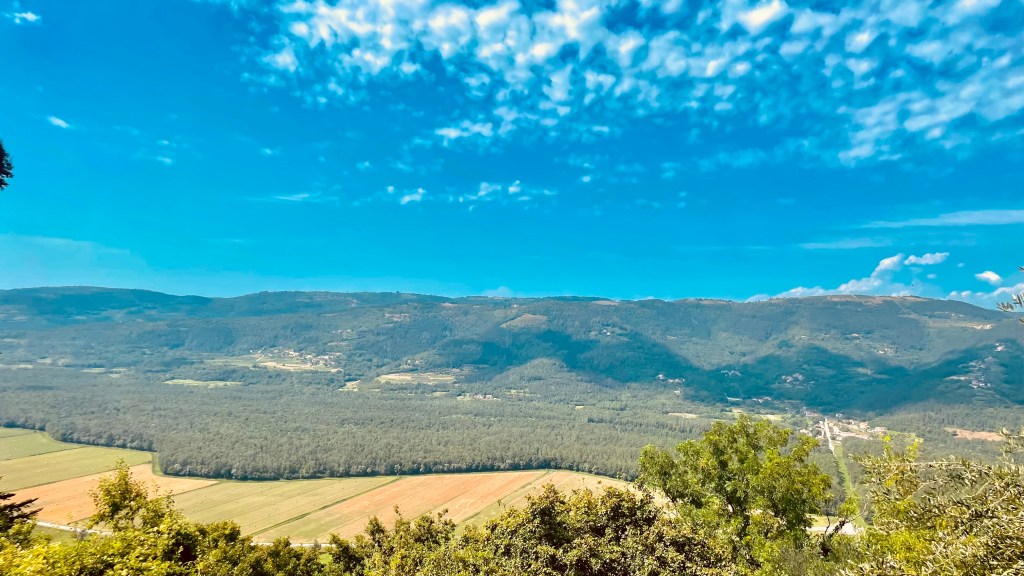
As the bus passed flooded crop fields and straddled sheer rocky hillsides, we made our way down into the Mirna River Valley, heading south. I’m not sure what I expected to see when I first arrived in Croatia, but it certainly wasn’t corn fields and tractors. In all honesty, it actually felt a little bit like I was still in Iowa, where I live. Apart from the large foothills that peaked up on either side of the valley we were traveling, the landscape felt oddly familiar. I began to worry that this trip may not be as enlightening as I initially hoped. I wondered if I would come away from the whole experience, having learned and seen nothing to give me any perspective on where my people came from. Thankfully, these anxieties were short-lived. An hour into the bus ride, I peered out of the window and saw my destination. Way up high above me sat what looked to be an ancient fort, complete with thick, sturdy walls and a high vantage point atop the tallest hill for miles in any direction. As the bus hissed to a smooth stop and the doors jolted open, I stepped off to see the rest of the group I would spend the day with. It was a small batch of people, mostly other tourists like me. I took my position in the back of the group, as I normally do, and our guide, a cheery middle-aged woman, welcomed us to the village of Oprtalj. Walking up the steep road towards the entry gate, I stared at the defensive walls that emerged from the cliffs flanking each side of the town. They arose from the ground as if they were pushed up from deep inside the Earth by tectonic forces. The village itself, from that angle, looked like it was lazily clinging to the hill in an attempt not to slide off. The Venetian-style houses and shops rose up tall, giving the entire thing a top-heavy and precarious feel.
Our guide led us through the narrow, cobbled streets (where we saw more cats than people) to explain the village’s history and give us tastes of Croatian culture along the way. At our first brief stop, we sampled olive oil in a courtyard as she told us that Oprtalj sits on a 1,240-foot high hilltop. She went on to explain that the village used to be a medieval fort, like most other towns in the region. Before that, during the Roman period, a military base sat in that location. And even before that, a prehistoric fort settlement was there. This oldness gave the town an unkempt look. The walkways were uneven, the paint on the houses chipped and peeled off from the sun, and native plants crawled out from cracks in the alleyways. If I hadn’t known better, I would have thought that the place was simply uncared for, but a large carving of the lion of St. Mark made in the 14th century reminded me that it isn’t. It’s just old. And for a place that has had a constant human presence since the late Bronze Age, it looks pretty damn good. I was struck by the notion that it’s entirely possible that my own ancestors had scaled this hill thousands of years ago. I don’t have any proof that they did, but I also can’t say for sure that they didn’t.
From the courtyard, the group and I continued our tour of the ancient town, stopping to experience other examples of Croatian culture. We ate smoked meats and cheeses dipped in truffle pastes, watched woodworkers craft hand-made furniture to sell, and listened to traditional Croatian music performed by instruments made from cow-stomach bagpipes and lutes with strings fashioned from horse hair. Through all of this, I was still waiting for that “Aha!” moment when my connection to this land clicked. I hoped the music might have awakened something in me, or maybe the food would unlock some distant sense of belonging. Unfortunately, they didn’t. The landscape’s familiarity made me realize why my ancestors settled in the Midwest, though. For them, coming from so far away and starting a life in a completely foreign land, the Midwest probably reminded them of home. Instead of hunting for truffles, they hunted for morels. The cornfields, open land, and welcoming people of Iowa, and Illinois, and Missouri likely felt just enough like Croatia that they decided to stay there. I can only imagine that they felt similar to how I did as I looked out over the village’s walls into the rural landscape. It reminded me of home, but only barely.
A Poser No More
With the sun falling low into the sky, we all followed our guide to the bus waiting to bring us back across the border into Slovenia. On the way, she bounced around to different people, asking them how they enjoyed their time, and from the laughter and smiles of everyone, it seemed they all had pleasant ones. However, when she finally approached me about halfway to the bus, she didn’t ask if I enjoyed the sights and sounds of the village. Instead, she told me that when she saw my name on the list of tourists, she immediately recognized it as Croatian. She said that she knew many people with the very same last name and that it was nice to meet a fellow Croat, even if I came from far away. The sound of a stranger pronouncing my last name correctly was unique to me. Most people get it wrong, and it usually takes them two or three tries before they say “Ah, ok. Mill-uh-titch.” But there in the Croatian countryside, I talked with a stranger, who pronounced it right, about my family’s history, and what it is like being where they started. That was my “Aha!” moment. I no longer felt like a poser. I realized that I never was one. I saw the same thing in this tour guide that I saw in myself and all the other Croatian-Americans I have talked to: pride for where we come from, and a desire to talk to those with the same origin as ourselves. I could tell she felt a similar connection that I had felt many times before. The connection between two people who share something in common. We share a history, and a friendliness, and a passion for our own people because Mi smo Hrvati—we are Croatians.

 Miletich Writing
Leave a reply to jimromagraham Cancel reply