
Last spring, my brother and I took a road trip, exploring South Dakota, Wyoming, Montana, North Dakota, and Minnesota. While in South Dakota we spent the night in Badlands National Park; this story recounts our experience there. It was originally published in Issue 05 of American Heartland Magazine.
As my brother, Parker, steps out of his truck, his feet impact the Earth with a thick, hollow thud. His truck is caked in the fine-grain gray dust of the open prairies. When he closes the driver’s side door behind him, that thin layer rises off in a nearly imperceptible cloud and returns into the wind from which it came. I follow his lead, though instead of stepping out, I hop down from the side step. Parker is a large man. He always has been. Thus, he steps out, and I hop down. With a deliberate stride, he rounds the hood, eyes glued to the view before us. Mine are too.
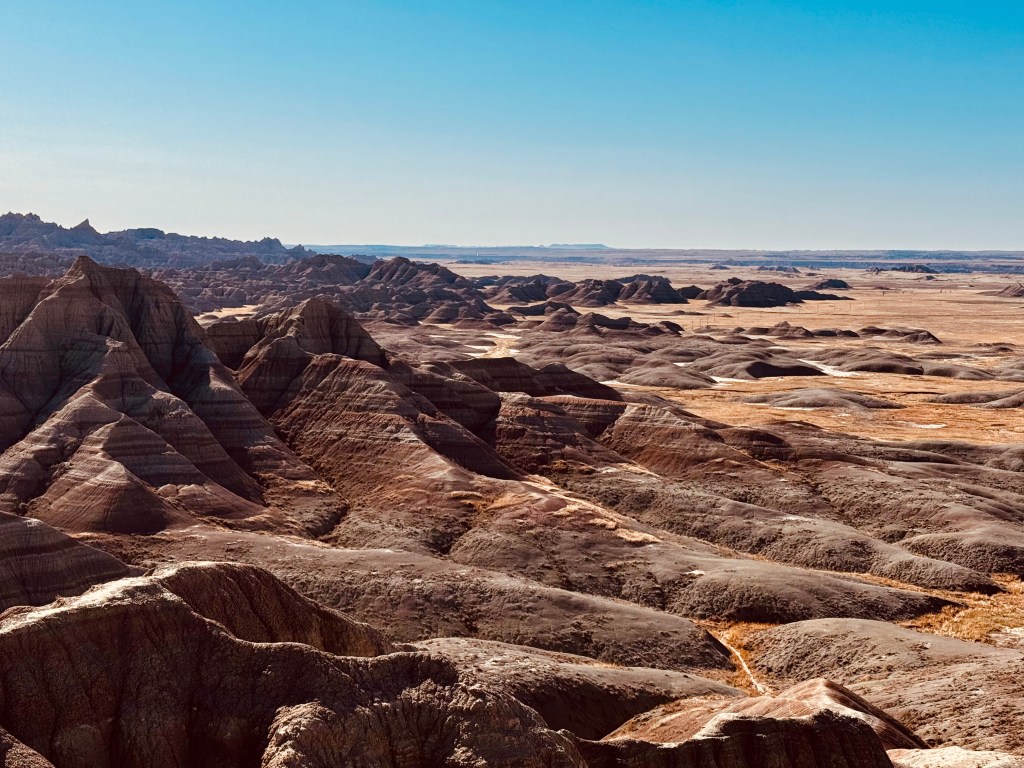
The view in question is a landscape beyond anything I thought possible: Badlands National Park. Presently, we stand atop the aptly named Pinnacles Overlook. This vista provides us, along with some fifteen other tourists, an idyllic vantage point to admire the incomprehensible scale of this alien-looking world. It is a labyrinthine maze of eroded buttes, sharp pinnacles, sandstone walls, and clastic dikes unfolding endlessly into the hazy beyond. On the distant horizon—past the intricate network of stone—stretches the long arm of the Black Hills. Within its resilient pre-Cambrian granite peaks, Mount Rushmore lurks among the blue pines. And though I cannot make out its four faces from this viewing platform I share with my brother, I am sure that I can see every last inch of the 242,756 acres that compose the Badlands; maybe even the whole world.
“I think this is the best view I’ve ever seen, brother.” Parker proclaims candidly.
I cock my head to look at him. “Really?” I ask.
“Yeah, dude. Just look at it.”
And so I do, scanning the expanse cast in the silver glow of mid-morning. It is beautiful. Still, I’m surprised by my brother’s definitive statement. After all, we have been to many places and seen many things, many of which commanded awe-inducing capabilities in their own right. A Rolodex of locations flips through my mind—the Colosseum, Stonehenge, Spanish oceanfronts, Croatian countryside, castles, cityscapes, and so on. I thumb through them all, estimating their weight as I slowly begin to nod. Eventually, a wide grin works its way across both of our faces, and I am certain he is right. It’s the best view I have ever had, too.
The clock read 5:36 am as Parker and I were driving eastbound on I-90 earlier that morning. Shrinking in the rearview was an 80-foot-tall green concrete brontosaurus—an eye-catching advertisement for the famous roadside tourist trap Wall Drug Store. It is a fitting sculpture, seeing as a hundred and fifty million years ago, that very long-necked sauropod lumbered through these lands in the flesh. We continued on the interstate for twenty miles before Parker steered the truck into the exit lane, hanging a right at a decommissioned Minuteman ballistic missile silo. The road markers read SD-240—the Badlands Loop. Soon, we would leave the Great Plains and enter a landscape more befitting of the Martian surface than anything native to our planet.
In dramatic fashion, the upper and lower prairies are separated by a steely formation of banded rock called the Badlands Wall—our destination that morning. Stretching for over sixty miles from Kadoka past the town of Wall, this intricately carved cliff serves as the gnarled spine of the Badlands National Park. While such a violent-looking landscape might seem the result of a cataclysmic event, in reality, it is the progeny of time, wind, and water. Five hundred thousand years ago, in a primeval America, the White River set out to scar the Earth. On its way to its rendezvous with the mighty Missouri, the river carved its way through these windswept plains, scraping out and wearing down the rock. What Parker and I saw that day, then, was not creation, but erosion—constant and endless. In another five hundred thousand years or so, this strata of rock will have fully succumbed to the White River, leaving no trace it was ever there at all.
Along the twisting course of SD-240, Parker and I witnessed astonishing landforms as the Wall opened up before our very eyes. It revealed itself timidly at first, allowing us only narrow glimpses of its magnitude—never all of it. But as we gained the land’s trust by negotiating the sinuous route, it became more confident in itself, and we were permitted more expansive views. We dipped down into the lower prairie through narrow passes once used by homesteaders, before climbing again to the upper rim; we stopped and marveled at every overlook, aghast at the scale and ruggedness of our surroundings. We were sure there would be no superlative view around the bend, and the Badlands would prove us wrong every time.
Those lands have tremendous power over the human mind, eliciting any number of feelings: Awe, respect, appreciation. I was engulfed by a sense of remarkable smallness before that Martian landscape on Earth. It would not be until we left Pinnacles Overlook that I was released from this spell, and I remembered just how little sleep I had gotten the previous night.
A low spot in barren lands is how I would describe our campsite the day before our scenic drive and glorious view at Pinnacle Overlook. To our south, the dried-up corpse of Sage Creek lay motionless. Flanking us on all other sides were steep, angular hills that echoed out in every direction. Trees were an exceedingly rare sight there, almost absent from the landscape entirely. Only in the drainages between hills did small clusters of trees and scrub brush gather together. Apart from that, and a few solitary junipers scattered about, the landscape was dominated solely by the mixed-grass of the prairie. It seemed to me to be an ocean of loneliness and solitude—its waves: the khaki grass in the breeze. Fifteen hours later, we would discover the more striking side of the Badlands at the wall, but for that day, we would be surrounded by its more muted half.
Lashed by a steady wind, Parker and I engaged in a fierce battle with our tent (which was more inclined to become a parasail than a shelter). It did not take long for us to admit defeat and sequester it back into the truck’s bed. In its stead, we brought out another, smaller tent. It was far easier to assemble and less apt to fly away, but it did have one fatal flaw: it lacked a rain fly. A quick check of the weather forecast, though, revealed that this would not be a problem. Clear skies, according to Mr. Weatherman, were all that awaited us in the foreseeable future. With it flapping in the currents of the air, we stepped back to admire our handiwork as if we had constructed a grand fort. It was a meager blue nylon fort, barely clinging to thirsty ground, but it would be our fort nonetheless—Fort Miletich. And as long as no rain came pelting down from above, it would keep us sheltered and happy.
Being Easter Sunday, we knew that everything of human creation would be locked up tight. So, after a brief discussion, we came to the same conclusion: The wilderness would not close for the holiday, and we ought to see some of it before the sun descends behind the hills. So, I thought, we shall do as the buffalos do. Roam!
While the Buffalo were not visible that day, their sign was evident everywhere we looked. On the picnic table a few feet from our humble fort were little tufts of their dark brown coats left behind from a serious scratching session. The ground was a minefield of buffalo chips, which, if not for a burn ban in the park, we might’ve used as a fire source just as the pioneers and Indians had. Maybe twenty or thirty yards to our eastern flank were the shallow divots of their well-used wallows. The air held the faint scent of their musk. And, of course, criss-crossing the landscape in every direction were the countless miles of their worn trails. They would be our trails, too, and we would follow in the hoofsteps of the bison, serenaded by the cries of prairie dogs warning their neighbors of two unbidden intruders in their kingdom.
I entered our tent that night, desperate for repose. While waiting for my inflatable pad to fill with air, I unrolled my sleeping bag, sweeping it flat on my half of Fort Miletich. My sleeping arrangements when camping are simple—totalitarian. It may not lend itself to great sleep, but with my travel pillow, distended pad, and insulated cocoon, I would sleep all the same. I found that my brother has a different philosophy. Why should he have to sacrifice the quality of his sleep just because he is resigned to spending the night in a tent? Thus, as he unfolded his small army cot and unraveled his double-wide sleeping bag, I looked on in great envy. Compared to me, I can only assume he was in a cloud of comfort. I was groveling in the stone age, and he was levitating in the chrome-plated future. My only consolation was that he forgot his pillow.
Night was quick to place its hand on the shoulder of day, and darkness supplanted light. What few molecules of warmth were left in the air were promptly abolished from that place—carried away in a bitter gale. Overhead, a gaunt-looking layer of clouds marched across the sky, and though they appeared not to sag from the weight of rain, Parker and I checked the weather forecast once more.
“Well, it still says no rain. We should be good without the fly.” I informed Parker.
Parker shimmies deeper into his bag. “Sounds good,” he yawned.
If we had powers of precognition, we would not have uttered the words “Good night” in the gloom of that evening; it would not be. We lay quiet, our tent flapping unceasingly in the wind. Its rhythm—fwap, whoosh, fwap, fwap, whoosh—pulled us ever closer to the dreamworld. At 10:00 pm, something pulled me back from the brink, though: the distinct sound of rubber on gravel. A large dually entered the campsite and slowly circled the grounds. Its occupant, no doubt, was looking for a primo location free from buffalo chips. We couldn’t blame him for that. We only wished he had turned off his high beams. Parker and I sat up as the truck crept past our tent, washing us in the piercing glow of its headlights. We glared at each other before Parker broke our silence by chuckling and turning over. “This dude’s bustin’ a slow creep with his brights on,” he whispered. We shared a good laugh at this.
Mr. Courteous, as I sarcastically began to think of him, spent the next thirty or forty minutes stumbling and cursing in the dark as he fought the wind to erect his tent. His headlights remained on the entire time. I knew he had finished constructing his tent when we were once again left with only the fwap-whoosh lullaby of our own. I hoped that sleep would embrace me soon, but it was not to be. My eyes were forced open when something was added to the soundscape—the cadenced fwap-whoosh was suddenly joined by a subtle pitter-patter. I reached out and ran my hand against our mesh ceiling. Shit.
Parker stirred slightly. “Is that what I think it is?” he asked groggily.
“Yeah, rain,” I sighed.
One might doubt that a sprinkle can make life hell, but I no longer can. The persistent misting never left us more than slightly damp, but it rendered sleep an impossible task. And so, Parker and I lay for hours in a state of limbo; not asleep, but eyes closed. I would frequently turn to my watch, hoping that dawn was not far away, only to be left deflated each time; only twenty minutes had passed since my last check.
I believe it was just after three in the morning when I was awakened by Parker unzipping the tent to go relieve himself in the dark. I was struck by several things: First, how cold my face was. It must have been in the mid-thirties that night, seeing as my breath formed into crystalline structures in the air. Next, my attention turned to the bright light coming from my right-hand side. It seemed to me that someone, maybe my own brother, was shining a flashlight at the tent. Leaning up, I was dismayed to find only the moon—I had no idea it could get so bright. I slumped back down into my sleeping bag, which by this point had a busted zipper from all my tossing. As I did, I realized the world was taciturn. There was no wind. There was no rain! And looking past the netted ceiling, I saw that there were no clouds either. A gleaming canopy of stars in the trillions had taken its rightful place in the sky. Constellations had no meaning in that celestial blue glow; there were far too many stars to pick even a Dipper out. At that moment, I didn’t care if the morning ever came, so long as those heavens remained.
The sunrise to the turkey and the coyote must be something divine; they would loathe to see a single soul miss it. Thus, in the soft glow of pre-dawn, Parker and I were awoken to the reveille of gobbles and howls. We emerged from the tent into a world transformed by frost—a world that invites stillness. My want for the truck’s heater and a hot cup of coffee, however, kept me moving when it would have been easier to sit inertly.
It was shortly after we were fully packed up when the sunrise came, and what a sunrise it was. The turkeys and coyotes were right to be worshipful. It was the kind of thing that breathes life into inanimate bones; that stirs a landscape. With its overhead summit in progress, the sun instilled a restlessness into the land. Prairie dogs chirped their alarms as a bull buffalo, stiff like an old man in the cool morning air, lumbered through their property. Behind him, a magnificent sunrise burned in the most vibrant of oranges. And as he plodded ever closer, with the rolling landscape and brilliant background, I was incapable of thought. I was engulfed in utter magnificence, and as the bull passed by, I was sure that I would be presented no greater view that day; and perhaps not for many years to come. Only God himself knew that hours later, I would be proved wrong.
It is far easier in these kinds of places—wild places, composed of extremes—to recognize when your life is very briefly becoming a story. It was under that brilliant orange, standing next to my own blood in the land of light and stone, that I became sure that that morning did not happen; it was written. What eluded me—what time could only tell—was whether this was a beginning or an end.


Leave a Reply